5 Signs Your Gym Is Charging You Without Consent
Seeing gym charges after you canceled? Learn five warning signs—unexpected fees, duplicate charges, price hikes—and why certified mail is solid proof.
The five signs your gym is charging you without consent are: charges appearing after you've canceled, annual fees you weren't told about, rate increases without notice, charges for services you never signed up for, and continued billing after your contract ended. If you see any of these, you may be entitled to a chargeback through your bank.
Frustrated by unexpected gym charges? You’re not alone. Gyms often make quitting harder than it should be, slipping in fees you didn’t expect or ignoring your cancellation requests. Here’s the bottom line: if you’re seeing charges after you’ve canceled, surprise fees, or unexplained price hikes, it’s time to take action.
Key Takeaways:
- Watch your bank statements. Look for charges you didn’t approve, like annual fees or duplicate payments.
- Document everything. Always get cancellations in writing and keep proof, like certified mail receipts.
- Know your rights. Under the Fair Credit Billing Act, you can dispute charges if you have evidence.
If your gym is giving you the runaround, services like ByeGym can handle the cancellation process for you. Let’s break down the 5 warning signs and how to protect your wallet.
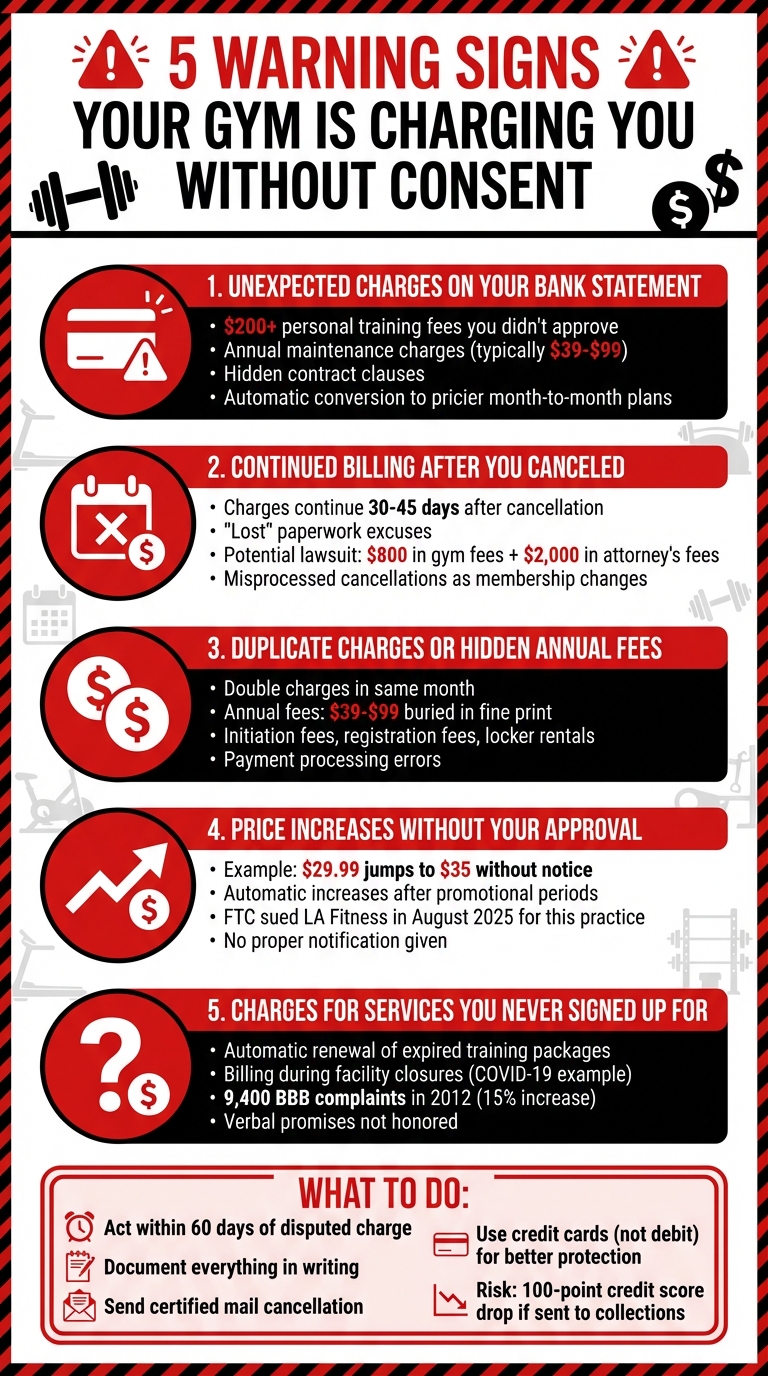
5 Warning Signs Your Gym Is Charging You Without Consent
Why Automatic Cancellation Is a Gym Billing Myth 🏋️♀️💳
1. Unexpected Charges on Your Bank Statement
Seeing surprise charges from your gym on your bank statement can be a frustrating experience. Whether it’s a $200 personal training fee or an annual maintenance charge you never agreed to, these unexpected debits often stem from hidden contract clauses or unauthorized billing. These charges can be a warning sign of larger billing issues down the line.
Surprise Fees on Your Statement
Take the case of John Stark, an editor at Next Avenue, who uncovered an unpleasant surprise in January 2013. His Minneapolis gym charged him $200 per month for two months - a total of $400 - for personal training sessions he thought he had canceled. Although Stark had verbally terminated the sessions, the gym pointed to a clause requiring written notice and refused to refund the charges. Instead, they offered session credits as compensation [3]. This situation highlights how gyms often rely on automatic conversion clauses to continue billing unless you follow their exact cancellation rules.
Sneaky Contract Clauses
Gyms are also notorious for sneaking in annual facility fees that catch members off guard. These charges are separate from your regular monthly dues and can feel like they come out of nowhere [3]. Things can get even trickier if your fixed-term membership - say, a six-month plan - automatically converts to a pricier month-to-month membership. If you don’t provide the required written notice before the term ends, the gym may continue charging you indefinitely.
Attorney Thomas J. Simeone sums it up well:
"Gym contracts are often difficult to terminate... That's not an accident. It's something gyms want to discourage, because every day, week, or month that you remain a member, you're paying more money" [7].
These practices are designed to keep you paying, whether you’re aware of the charges or not.
2. Continued Billing After You Canceled
You canceled your membership - yet somehow, your gym keeps charging you.
Failure to Honor Cancellations
Gyms have a bad habit of mishandling cancellations. Sometimes, staff misfile your paperwork or mistakenly process it as a membership change, which keeps the billing cycle alive. Attorney Fletcher R. Carpenter explains just how far this can go:
"Long after you thought you 'canceled' your gym membership, you'll get a knock on your door with a court summons demanding that you pay $800 in gym fees and $2,000 in attorney's fees. It sounds crazy, but it happens." [7]
Most gym contracts require 30 to 45 days' notice for cancellations to take effect—which is why it's important to cancel your membership properly from the start. That means you might still see one last charge after submitting your request. But if your gym "loses" your paperwork or claims they never received it, those charges can drag on indefinitely [7].
Even when your cancellation is officially recorded, some gyms find ways to tack on extra fees, exploiting vague or confusing rules.
Extra Fees That Add Up
Gyms often sneak in final or administrative fees, even after processing your cancellation. Many require you to follow strict procedures, like sending cancellation requests to a corporate office. If you miss a step, they may claim your cancellation wasn’t valid, leading to more charges [3][4].
Attorney Thomas J. Simeone stresses the importance of keeping a paper trail:
"The general rule of thumb is 'get it in writing and keep it all,' because somewhere down the road, if you need to prove the agreement or the date you terminated... you'll have a better chance of it holding up in small claims court." [7]
Without proof - like certified mail receipts - disputing these charges becomes a lot harder.
3. Duplicate Charges or Hidden Annual Fees
Billing surprises like duplicate charges or hidden annual fees can point to bigger problems with your gym's billing practices. You might notice two charges from the same gym in one month or a random fee - sometimes as high as $99 - that you didn’t expect or agree to.
Charges You Never Agreed To
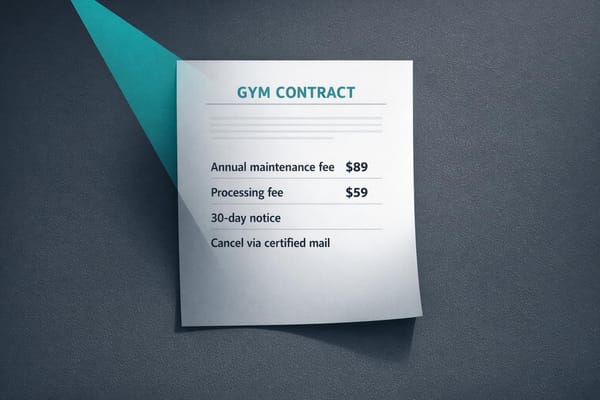
Many gyms charge an annual maintenance fee on top of your monthly dues. These fees, often ranging from $39 to $99, are sometimes buried in the fine print of your contract and not clearly explained. On top of that, duplicate charges can happen due to payment processing errors. Services like personal training may also be billed separately, which can lead to confusion if you're not expecting it[3].
There are also cases where gyms automatically convert expired packages into month-to-month memberships and continue billing without notifying or getting approval from the member. These practices can leave you paying for something you didn’t knowingly agree to[3].
Vague Terms and Verbal Promises
Hidden fees are another common issue. Besides your monthly dues, gyms can tack on initiation fees, registration fees, or extra charges for things like locker rentals or towel service. The New York State Division of Consumer Protection highlights how these fees can inflate what seemed like a reasonable price:
"While the advertised monthly fee may seem reasonable, gyms often include additional fees for things like initiation, cancellation, and maintenance. These fees can quickly add up and leave you with a much higher bill than you expected."[8]
To protect yourself, make it a habit to review your bank statements each month and match every charge to your contract. Using a credit card instead of direct bank withdrawals can also give you better tools to dispute unauthorized or duplicate charges if they occur[1][6].
4. Price Increases Without Your Approval
One red flag that your gym might be charging you unfairly is a sudden spike in your monthly fee. For example, you might notice $35 being withdrawn from your account instead of the $29.99 you originally agreed to, or see your introductory rate jump unexpectedly after just a few months. These increases go against the terms you consented to when you signed your contract.
Unapproved Rate Increases or Service Add-Ons
Unlike sneaky hidden fees, these rate hikes are blatant changes to your agreed-upon payment. Many gym contracts include clauses that allow automatic price increases after promotional periods, but gyms often skip giving you proper notice. This leaves you blindsided when the higher charge appears. A notable example of this practice came in August 2025, when the Federal Trade Commission sued L.A. Fitness for deceptive tactics, including unapproved price hikes and delaying cancellations [10].
To stay ahead of these tactics, make it a habit to compare your monthly charges with the terms outlined in your original contract. If you spot an increase you didn’t approve, act fast. Keep a record of the changes, and consider sending a cancellation notice through ByeGym’s certified mail service. This provides you with court-admissible proof and ensures your rights are protected.
5. Charges for Services You Never Signed Up For
Seeing charges for services you never agreed to can be a nasty surprise, slowly draining your account without your knowledge. Unfortunately, many gyms make it frustratingly hard to get refunds for these unauthorized charges.
Billing for Services You Didn't Request
Gyms are notorious for turning limited-term services into ongoing monthly fees without asking for your consent. For example, you might finish a personal training package only to find your account being debited for additional sessions you never approved. When you confront the gym, they’ll often point to obscure clauses buried in your contract to justify the charges [3].
It doesn’t stop there. Some gyms even charge members when their facilities aren’t open. A glaring example comes from April 2020, when Town Sports International (TSI) - the company behind gyms in Boston, Philadelphia, and Washington - kept billing members while their locations were shut down due to the COVID-19 pandemic. Legal pressure from attorneys general in Pennsylvania, New York, and Washington, D.C. finally pushed TSI to freeze accounts and offer credits [2]. As Edgar Dworsky, founder of ConsumerWorld.org, bluntly stated:
"If a member's health club is closed, they should not have to pay for services that are not being provided. They're owed a refund - it's that simple" [2].
Unauthorized Services and Add-Ons
Unauthorized charges often arise from vague renewal terms or verbal promises that don’t hold up legally. Salespeople may assure you that canceling is straightforward or that certain perks are included, but if these guarantees aren’t written into your contract, they’re unenforceable [5][7]. In fact, deceptive billing practices are a widespread issue. Back in 2012, the Better Business Bureau logged around 9,400 complaints against health clubs - a jump of 15% from the previous year - with many grievances tied to unclear or sneaky billing practices [3].
If you notice charges for services you didn’t approve, act fast. Start by comparing your bank statements to your original contract to identify any discrepancies. Once you spot an issue, send a cancellation notice using ByeGym’s certified mail service. This approach provides court-admissible proof of delivery, ensuring the gym can’t deny receiving your notice. If they continue billing you after that, ByeGym will supply a chargeback kit with all the paperwork you need to dispute the charges with your bank.
What to Do If You Spot These Signs
Time is critical here - you have 60 calendar days from when the disputed charge appears on your statement to file a dispute with your credit card issuer [6]. Start by carefully reviewing your bank or credit card statements and comparing each charge to the terms in your gym contract. Keep an eye out for charges that are higher than agreed, show up after you tried to cancel, or cover services you didn’t approve.
Document everything in writing. As Matthew Becker, Founder of Gym Lawyers PLLC, advises:
"Cancellations, and conversations around cancellations, should always be in writing" [9].
Write down every call you make, noting the date, time, and the name of the employee you spoke with. Save copies of all emails, letters, and any other correspondence. This paper trail can be essential if your gym keeps billing you or escalates the issue to collections.
The most effective way to stop unauthorized charges is by sending a certified cancellation letter. Many big gym chains, like Planet Fitness, require a physical letter or certified mail to officially process your cancellation [13][14]. If you want a straightforward and legally solid way to handle this, there’s a solution.
ByeGym can take care of this entire process in just four minutes. They create a cancellation letter tailored to your state’s consumer protection laws, including federal regulations like the FCBA and EFTA. Then, they send it via USPS Certified Mail with an Electronic Return Receipt, giving you proof - admissible in court - that your gym received your request. You’ll also get a tracking dashboard to monitor the delivery during the typical 35–45 day cancellation period. If your gym keeps charging you after the notice period, ByeGym provides a chargeback kit with all the documentation you’ll need - certified mail receipt, delivery confirmation, and more - to dispute the charges with your bank.
Another layer of protection comes from your payment method. Always use a credit card instead of a debit card or bank transfer. Credit cards offer stronger legal safeguards for disputing unauthorized charges. During an investigation, disputed charges are usually suspended, unlike with debit cards, where your money often remains tied up until the investigation is complete [6]. If the charges don’t stop, consider opening a new bank account to block further access [12].
Why Certified Mail Protects You Best
If you're serious about canceling your gym membership without headaches, certified mail is your best ally. It creates a rock-solid paper trail that gyms can't ignore. When they pull the classic "we never got your request" excuse, certified mail shuts that down. Why? It requires a gym employee's signature upon receipt, leaving you with a date-stamped record that's legally admissible in court [6]. As financial expert Thomas (TJ) Porter explains:
"Having written proof that you've canceled your account offers a strong defense against claims of nonpayment" [11].
This level of documentation becomes critical if your gym continues charging you after you've canceled. That certified mail receipt can make all the difference when filing a chargeback with your bank. It proves the gym was properly notified and removes any "he-said-she-said" ambiguity, which often works in the gym's favor [6].
Many gym contracts even require certified mail for cancellations. For instance, in August 2025, the FTC filed a complaint against LA Fitness for shady practices, like forcing members to send hard-to-find forms via certified mail while rejecting phone and email cancellations. These tactics reportedly cost consumers hundreds of millions in unwanted fees [15]. This highlights why a signed, date-stamped receipt is so important - gyms often design their systems to make quitting as difficult as possible.
The consequences of not having this proof can be severe. If your account is wrongly sent to collections because you can’t prove you canceled, your credit score could drop by 100 points [11]. That’s a financial headache nobody needs. Protect yourself by securing undeniable proof of your cancellation.
For a hassle-free option, ByeGym can handle the certified mail process for you. They’ll send your cancellation letter via USPS Certified Mail, provide an electronic return receipt, and even give you a tracking dashboard for the 35–45 day process. If needed, they also include a chargeback kit to help you dispute unauthorized charges.
Stop the Charges—For Good
Unauthorized gym charges don't have to keep draining your account. Whether it's duplicate fees, post-cancellation billing, or hidden annual charges, you have the right to end it—and to have proof that you did.
Certified mail isn't just a formality. It's your leverage if the gym ignores your request or your bank asks for documentation. One letter, sent the right way, can save you months of back-and-forth.
Ready to cancel the right way?
ByeGym sends your cancellation via USPS Certified Mail with proof of delivery—so you have documentation if the gym keeps charging you.
Send My Cancellation Letter →FAQs
What's the fastest way to stop unauthorized gym charges?
Unauthorized charges from gyms can crop up when cancellation policies are vague, or gyms keep billing after closures or missed deadlines. To avoid these headaches, always review the cancellation terms before signing up. Pay attention to details like early termination fees, and make sure to get all agreements in writing.
To stop unauthorized charges, your best bet is to send a formal cancellation letter through certified mail and keep proof of delivery. This creates a clear paper trail in case you need to dispute charges later. If that sounds like a hassle, ByeGym can handle it for you. They draft a cancellation letter customized to your gym’s policies and state laws, send it via USPS Certified Mail with an electronic return receipt, and even track the delivery. Should your gym continue billing you after cancellation, ByeGym equips you with a chargeback kit, including all the documentation needed to dispute charges with your bank. This ensures you have solid evidence to fight against unwarranted fees.
My gym keeps billing me after I canceled—what now?
If your gym keeps charging you after you've canceled, take action by sending a certified-mail cancellation notice. This creates a clear paper trail and gives you proof that you requested to end your membership. If you’d rather not handle this yourself, services like ByeGym can take care of it for you. They’ll draft a proper cancellation letter and provide proof of delivery, saving you the hassle.
Should the charges continue even after the cancellation period has passed, you have the right to dispute them with your bank. Present your certified-mail receipt along with any other documentation to support your claim. This evidence can help you recover unauthorized charges and ensures your rights as a consumer are upheld.
Do I really need certified mail, or is email enough?
Certified mail gives you proof of both sending and delivery, which is crucial if your gym challenges your cancellation or keeps charging you. With a signed delivery confirmation, you’ll have legally-admissible evidence to back you up against any unauthorized charges.
It also eliminates common excuses like "we never received your paperwork" or claims that your request got "lost." This simple step ensures your cancellation is documented and helps you avoid unnecessary headaches.